
In the world of modern art, few artists capture the complexity of human experience quite like Theo Tobiasse. His canvases pulse with vivid reds, luminous golds, and deep blues, each hue carrying its own emotional message. Each painting tells a story layered with memory, identity, love, and survival. Tobiasse’s work invites you into a visual narrative where lovers embrace beneath starlit skies, birds carry messages of hope, and windows frame glimpses of distant homelands. His paintings transcend mere imagery, transforming personal history into visual poetry that speaks to us all.
At Elliott Gallery in the heart of New Orleans’ French Quarter, we’re honored to share Tobiasse’s extraordinary vision with collectors and art enthusiasts. His work resonates deeply with those who understand that great art does more than please the eye—it speaks to the soul.
 A master of original graphics, Tobiasse personally created his own plates and oversaw the entire printing process, ensuring authenticity in every piece. His impact on the art world endures, as his evocative works continue to speak to themes of exile, memory, and resilience—inviting viewers to explore the profound emotional landscapes he so masterfully depicted.
A Life of Movement, Memory, and Meaning
From Lithuania to Paris: The journey that shaped Tobiasse’s art
Theo Tobiasse was born in 1927 in Jaffa, Israel, but spent his formative years in Lithuania before his family fled to Paris in 1931. This early displacement planted seeds that would bloom throughout his artistic career. When World War II erupted, the teenage Tobiasse and his family went into hiding in the French countryside, surviving the Nazi occupation in secrecy and fear. His parents perished in the Holocaust, a devastating loss that would echo through his work for decades to come.
These experiences of exile, loss, and survival weren’t burdens Tobiasse merely carried, they became the foundation of his artistic language. The displacement of his childhood, the terror of the war years, and the grief of his losses gave his art an emotional depth that transcends mere aesthetic beauty. Every canvas became a space where he could reconstruct what was lost, honor what was destroyed, and imagine what might have been.
After the war, Tobiasse settled in Paris, where he initially worked in fashion illustration before dedicating himself fully to painting in the 1950s. This late start to his fine art career meant that when he finally picked up his brush, he brought a lifetime of experience, emotion, and observation to every stroke. His art emerged fully formed, mature, and deeply personal from the very beginning.
Finding light after darkness
What makes Theo Tobiasse’s art so compelling is not that it dwells on suffering, but that it transforms hardship into hope. His paintings are filled with themes of exile and homecoming, loss and rediscovery, darkness and illumination. Rather than depicting the horrors he survived, Tobiasse chose to paint the beauty that endures despite tragedy: the love that persists, the faith that sustains, the memories that refuse to fade.
This transformation of darkness into light was an act of defiance. Tobiasse refused to let tragedy have the final word. Instead, he created a visual language where beauty, love, and hope stand as testaments to the human spirit’s ability to endure, to remember, and to create meaning even in the face of unspeakable loss.
The Language of Color and Symbolism
A palette of emotion
When you stand before a Theo Tobiasse painting, color washes over you like music. His bold reds pulse with passion and vitality, speaking of love’s intensity and life’s warmth. His luminous golds evoke candlelight in synagogues, the amber glow of memory, the precious nature of moments preserved in time. His deep blues suggest night skies over ancient cities, the mystery of faith, the vastness of longing and hope.
His technique layered these colors with extraordinary richness. Tobiasse often worked with mixed media, combining paint with collage elements, creating surfaces that have physical depth and texture. This technical approach mirrors the layered nature of memory itself, the way our recollections accumulate, overlap, and create meaning through their interaction. The result is paintings that feel simultaneously ancient and immediate, dreamlike and intensely present.
Recurring motifs that tell his story
Throughout Tobiasse’s body of work, certain images appear again and again, each carrying symbolic weight that deepens with repetition.
Lovers appear often, their bodies flowing together in an embrace that defies gravity and logic. These couples represent connection, loyalty, and the human need for intimacy in an uncertain world. After experiencing so much loss, Tobiasse painted love as an act of resistance, a force that binds us together when everything else threatens to tear us apart.
Birds soar through his compositions, often carrying flowers or messages. In Jewish mysticism, birds can represent the soul, divine messages, or the connection between heaven and earth. They also suggest freedom, transcendence, and the possibility of carrying memories and dreams across borders and boundaries.
Windows and architectural frames create structures within his paintings, offering glimpses of distant places. These windows suggest both separation and longing, the view from exile looking back toward home.
Jerusalem itself appears repeatedly, rendered in golden light that makes the ancient city seem both real and mythical. For Tobiasse, Jerusalem represented spiritual homecoming, cultural identity, and the continuity of Jewish life and faith despite centuries of displacement and persecution.
Hebrew letters and text float through many of his compositions, sometimes legible, sometimes abstract. These fragments of language root his work in Jewish tradition while also serving as pure visual elements, the beauty of written words as image, not just meaning.
Love, Faith, and the Human Spirit
The heart of Tobiasse’s work
At the center of Theo Tobiasse’s artistic vision stands love, not as sentimental decoration, but as the fundamental force that gives life meaning. His embracing couples aren’t portraits of specific people but rather universal symbols of human connection, tenderness, and devotion. They hold each other as if nothing else in the world exists, creating islands of intimacy within the vast spaces of memory and longing.
This emphasis on love emerges naturally from Tobiasse’s personal history. Having lost his parents and witnessed the destruction of entire communities, he understood love’s preciousness and fragility. His paintings celebrate love not naively, but with the hard-won wisdom of someone who knows how easily it can be stolen away. The intensity of his lovers’ embrace reflects an awareness that we must hold tight to what matters most.
But Tobiasse’s conception of love extends beyond the romantic. His work expresses love of heritage, love of faith, love of beauty, and love of life itself. His paintings are acts of love for the memories he preserves, love for the culture and traditions he celebrates, love for the act of creation that transforms pain into beauty.
Spiritual undertones
Tobiasse’s Jewish identity permeates his work without overwhelming it. He wasn’t creating religious art in a traditional sense, but rather art that carries the emotional and spiritual resonance of his faith and cultural heritage. His paintings feel sacred without being didactic, spiritual without being exclusionary.
The presence of Hebrew text, the recurring imagery of Jerusalem, the symbolic use of light, and the emphasis on memory and continuity all reflect Jewish thought and tradition. In Jewish culture, memory itself is a sacred act, to bear witness and pass stories forward through generations. Tobiasse’s paintings fulfill this commandment, preserving memories of a world destroyed while celebrating the endurance of Jewish culture and spirit.
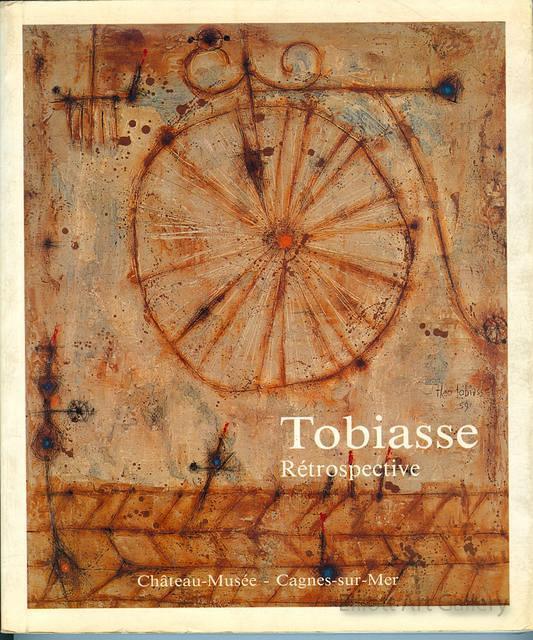
Tobiasse and His Artistic Circle
Inspiration and influence
Theo Tobiasse surfaced as an artist during a period when the School of Paris continued to influence modern art worldwide. He worked alongside and drew inspiration from masters like Marc Chagall, whose dreamlike imagery and Jewish themes provided a precedent for Tobiasse’s own narrative approach. Both artists used color expressively, depicted floating figures and lovers, and drew from their Eastern European Jewish heritage.
Tobiasse also absorbed influences from other modern masters. Like Joan Miró, he understood the power of symbolic imagery and bold color. Like Georges Braque, he appreciated the cubist approach to fragmenting and reconstructing space. These influences helped shape Tobiasse’s visual language while he developed his own distinctive voice.
The post-war Paris art scene provided Tobiasse with both community and context. He exhibited regularly, building relationships with galleries and collectors who appreciated narrative figuration at a time when abstract expressionism dominated much of the art world. His timing proved fortunate, as collectors began seeking alternatives to pure abstraction, Tobiasse’s story-rich imagery found an eager audience.
A voice of his own
Despite these influences and connections, Tobiasse’s work remains unmistakably his own. While Chagall’s paintings often have a whimsical, folkloric quality, Tobiasse’s work feels more grounded in lived experience, more emotionally direct. Where many of his contemporaries moved toward abstraction, Tobiasse remained committed to figurative storytelling, believing that the human form and recognizable imagery could carry emotional and spiritual meaning more powerfully than abstract shapes.
His technique also set him apart. The layered, almost collage-like quality of his paintings, the intense saturation of his colors, and the way he compressed multiple scenes and timeframes into single compositions created a visual style that was entirely his own. You can recognize a Tobiasse across a gallery, the particular way his lovers intertwine, the specific glow of his golden Jerusalem, the distinctive energy of his composition.
This individual voice explains why Tobiasse’s work has maintained its appeal for decades. His paintings don’t follow trends, they exist in their own emotional and visual world, which means they never go out of style. Collectors who acquire Tobiasse aren’t buying a fashionable name—they’re bringing home a piece of genuine artistic vision.
Why Collectors Love Tobiasse
Emotional storytelling meets timeless design
Theo Tobiasse occupies a rare position in modern art: his work is simultaneously deeply personal and broadly accessible. The symbolism in his paintings isn’t obscure or coded. You don’t need an art history degree to understand that his embracing couples represent love, or that his golden cityscapes speak of longing and memory. Yet this accessibility doesn’t make his work simple or shallow. Each painting rewards repeated viewing, revealing new details and emotional nuances over time.
For collectors, this combination proves ideal. A Tobiasse painting works beautifully as a design element. The rich colors, balanced composition, and visual drama make his work stunning on any wall. Unlike merely decorative art, Tobiasse’s paintings continue to engage intellectually and emotionally. They’re pieces you live with, not just look at, and they deepen in meaning as you spend time with them.
Collecting Tobiasse at Elliott Gallery
At Elliott Gallery, we’ve built our reputation over decades by offering authenticated works from important modern and contemporary artists. Our Theo Tobiasse paintings come with full provenance documentation, ensuring that collectors can acquire with confidence. We understand that purchasing fine art represents both an emotional and financial investment, and we provide the expertise and support that makes the collecting experience rewarding.
Our location in the French Quarter offers an intimate setting to experience Tobiasse’s work in person. There’s simply no substitute for standing before one of his paintings, seeing how the colors interact, appreciating the texture of the surface, and feeling the emotional impact of his imagery. We invite you to visit our gallery to view available works and discuss how Tobiasse might fit within your collection.
For those building collections of modern masters, Tobiasse pairs beautifully with other artists we represent—Chagall, Miró, and other School of Paris painters who shared his commitment to color, emotion, and narrative content. We’re happy to discuss how different artists complement each other and help you develop a cohesive, meaningful collection.
Experience Theo Tobiasse at Elliott Gallery
Theo Tobiasse’s legacy endures because he created art that matters, paintings that speak to fundamental human experiences of love, loss, memory, and hope. His work reminds us that even in the darkest times, beauty persists, love endures, and the human spirit finds ways to create meaning and connection. In New Orleans, a city that understands resilience, celebration, and the power of culture to sustain communities through hardship, Tobiasse’s message resonates particularly deeply. His work feels at home in the French Quarter, where art, history, and lived experience intertwine on every corner.
We invite you to discover Tobiasse’s powerful use of color and storytelling in person at Elliott Gallery. Whether you’re an experienced collector or just beginning to explore fine art, his paintings offer something rare: beauty that doesn’t shy away from complexity, emotion that doesn’t slip into sentimentality, and stories told in a visual language that transcends time and place. Visit us in the French Quarter during gallery hours, contact us through our form here, or call 504-895-9898 to schedule a private viewing. Let us help you discover why collectors worldwide treasure this remarkable artist’s vision.