Few living artists command a room the way Rafał Olbiński does. His paintings arrive fully composed, elegant, slightly unsettling, and impossible to look away from. A zipper dissolves into two faces. A swan becomes a rose. A dress contains a countryside. This is Rafał Olbiński art: intellectually playful, visually precise, and emotionally resonant in ways that linger long after you’ve left the room.
At Elliott Gallery in New Orleans, we are proud to present works by Olbiński to collectors in Louisiana and beyond. Whether you’re new to his work or looking to add a significant piece to an existing collection, our team is here to help you find the right painting.
About Rafał Olbiński
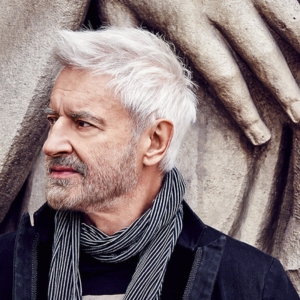 Rafał Olbiński was born in 1943 in Kielce, Poland, and trained as an architect at the Warsaw University of Technology, graduating in 1969. Though he never practiced architecture, that rigorous technical foundation would later define the architectural precision and spatial intelligence that sets his paintings apart from virtually every other contemporary surrealist working today.
In the 1970s, Olbiński emerged as a leading figure in the celebrated Polish School of Posters, a movement that used bold visual metaphors and symbolic imagery to communicate political realities under communist rule. His early poster work was striking for its single powerful image, rich color, and layered meaning: the kind of visual shorthand that stops a passerby cold.
In 1981, Olbiński traveled to New York for an exhibition of his poster work at the Polish Institute of Arts and Sciences of America. While he was there, martial law was declared in Poland. He stayed, and America claimed him as one of its own. Over the following decades, he became a prominent illustrator creating covers for The New Yorker, Time, Newsweek, The New York Times, and The Atlantic, among many others. His illustration work brought his imagery to millions of readers. His painting brought those same ideas into a more intimate, permanent, and collectible form.
He taught at the School of Visual Arts in New York. He has also designed stage sets for major opera companies, including the New York City Opera and the Philadelphia Opera.
Today, Olbiński is widely regarded as one of the foremost surrealist painters of his generation. He works primarily in acrylic on canvas, as well as graphite on paper, and his output spans fine art paintings, limited edition prints, and works on paper.
What Makes Rafał Olbiński’s Work Distinct
Olbiński occupies a rare space in contemporary art. His work rewards both the casual viewer and the dedicated collector. There is always more to find.
Poetic Surrealism with Symbolic Storytelling
Olbiński does not chase chaos or randomness. His surrealism is structured and intentional. Every impossible element earns its place within a larger visual argument. He draws directly from the tradition of René Magritte and Paul Delvaux, artists who used realistic painting techniques to render scenes that quietly defy logic. Olbiński’s works carry an undercurrent of longing, desire, and quiet humor. The familiar becomes strange, and the strange becomes somehow inevitable. It is this quality, the sense that his imagery should exist even though it cannot, that makes Rafał Olbiński paintings so enduringly compelling.
Architectural Precision and Theatrical Composition
Olbiński’s architectural training did not disappear when he became a painter. His canvases are spatially organized with an architect’s confidence. Figures inhabit rooms and fields and dreamscapes that feel built, not merely imagined. Sight lines are deliberate. Negative space is active. Elements enter and exit the frame with the control of a stage director, which makes sense: his years designing sets for opera productions are visible in every canvas. The result is work that feels simultaneously still and kinetic, like a scene frozen at its most charged possible moment.
Humor, Elegance, and Emotional Tension
One of the qualities that distinguishes Olbiński from many of his peers is his humor, not broad or obvious, but dry, precise, and aristocratic. His paintings often contain a punchline, but the joke arrives quietly, without fanfare. The elegance of the execution makes the absurdity sharper. At the same time, there is emotional weight in his work that resists easy reading. These are not merely clever pictures. They carry a sense of longing, memory, and theatrical pathos that reflects both his Polish roots and his decades of life as an émigré artist working between two cultures.
Rafał Olbiński Paintings and Works Available at Elliott Gallery
Elliott Gallery maintains a rotating selection of Rafał Olbiński works, spanning acrylic paintings on canvas and works on paper. Availability changes as pieces are acquired and sold, so we encourage collectors to contact us directly for the most current inventory. We are happy to discuss provenance, condition, and documentation on any available work.
Current Themes in Available Works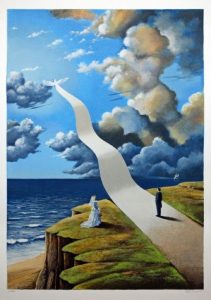
When sourcing Olbiński’s work for our collection, we focus on pieces that exemplify what makes his art collectible and distinctive:
- Figurative compositions with strong central metaphors: Works that anchor an impossible or symbolic image within a convincing sense of physical space
- Works featuring architectural or interior settings: Pieces that demonstrate his trained eye for structure and spatial drama
- Romantic and theatrical subjects: Paintings that reflect his operatic sensibilities, often with human figures in charged or ambiguous relationship to one another
- Works on paper: Graphite drawings that reveal his draftsmanship and are often more accessible entry points for new collectors
Find Rafał Olbiński Paintings in New Orleans
Elliott Gallery offers collectors the opportunity to view Rafał Olbiński art in person. New Orleans, with its own deep tradition of surrealism, symbolism, and theatrical visual culture, is a fitting home for his work. We invite you to visit our gallery or schedule a private appointment to view available pieces at your convenience.
How to Collect Rafał Olbiński Art
For collectors new to Olbiński’s work, or to fine art collecting generally, here is what to look for and consider when acquiring a piece.
What to Look for
Olbiński works primarily in acrylic on canvas for his finished paintings and graphite on paper for drawings and studies. Acrylic paintings are generally his most significant and sought-after works. Works on paper can be excellent entry points and often display his draftsmanship with particular clarity.
Original works should bear Olbiński’s signature, typically on the front or verso of the canvas. Ask for documentation of provenance, a clear ownership history adds confidence for both collecting purposes and any future resale.
As with any work on canvas, look for consistent surface texture, no evidence of flaking or cracking, and stable color with no significant fading. Our team at Elliott Gallery can walk you through the condition of any piece in detail before you make a decision.
Olbiński has produced limited edition prints in addition to original works. These carry separate value considerations from unique originals, and our team can help you understand the differences and which may be the right fit for your collection goals.
Display and Framing Considerations
Olbiński’s paintings are typically vertical or near-square in format, with strong central compositions that work well as focal points. Given his saturated palette and theatrical imagery, he is best displayed where a single work can command attention. We strongly recommend UV-protective glass or acrylic glazing for works on paper, and professional framing that complements but does not compete with the painting’s visual drama.
Elliott Gallery offers a framing consultation as part of our collector services, and our team can advise on lighting, placement, and presentation to help you display your piece at its best.
Olbiński’s Influence and Related Artists We Recommend
Rafał Olbiński did not emerge in isolation. His work sits within a rich tradition of European and American surrealism, and collectors who respond to his imagery often find deep resonance with several other major artists we carry at Elliott Gallery.
- Salvador Dalí is the most obvious touchstone. Like Olbiński, Dalí brought architectural rigor and hallucinatory precision to impossible imagery. Collectors who love the controlled chaos of Dalí’s dreamscapes often find Olbiński’s more lyrical, humane surrealism a compelling complement, or a natural next step.
- Marc Chagall shares Olbiński’s Eastern European sensibility and his commitment to love, memory, and symbolic transformation as subject matter. Where Olbiński tends toward cool elegance, Chagall is warmer and more expressionistic, but the emotional territory is recognizably kindred. Collectors frequently hold works by both.
- Joan Miró offers a more abstract counterpoint. Miró’s biomorphic forms and playful use of color and symbol rhyme with Olbiński’s symbolic vocabulary, even as the execution differs dramatically. Together, they trace the range of what surrealism can be, from the intensely literal to the freely abstract.
Experience Rafał Olbiński at Elliott Gallery
Rafał Olbiński’s art endures because it invites viewers into a world where beauty, wit, mystery, and imagination exist in perfect balance.
In New Orleans, a city shaped by performance, symbolism, music, and layered histories, Olbiński’s work feels especially resonant. His surrealist imagery belongs in a place where reality and imagination often seem to meet on the same street corner. At Elliott Gallery in the French Quarter, collectors can experience the refinement, humor, and narrative power of Rafał Olbiński art in person.
We invite you to discover Olbiński’s artwork at Elliott Gallery. Whether you are an experienced collector or just beginning to explore surrealism art for sale, his paintings offer something rare: visual drama with intellectual depth, beauty with tension, and storytelling that continues to unfold over time. Visit us in the French Quarter during gallery hours, contact us, or call 504-895-9898 to schedule a private viewing.
Ready to explore Rafał Olbiński’s work? Contact Elliott Gallery here to schedule a private viewing or inquire about available works.
FAQs about Rafał Olbiński Art
What is Rafał Olbiński known for?
Rafał Olbiński is known for his poetic surrealist paintings that combine impossible symbolic imagery with architectural precision, elegant draftsmanship, and a distinctive dry wit. He is also celebrated for his illustration work, including iconic magazine covers for The New Yorker and Time, and for his poster designs within the Polish School of Posters tradition.
Is Rafał Olbiński a surrealist artist?
Yes, though his surrealism is distinctly his own. Olbiński draws on the tradition of René Magritte and Paul Delvaux rather than the more chaotic or automatic approaches associated with other surrealists.
How do I know if a Rafał Olbiński work is authentic?
Authentic Olbiński works should carry the artist’s signature and, where available, documentation of provenance, a record of prior ownership or exhibition history. When available, Elliott Gallery provides documentation and provenance information, and our team can walk collectors through condition, signature, and authenticity considerations. We encourage buyers to ask questions and take the time they need to feel confident.
Do you ship Rafał Olbiński paintings?
Yes. Shipping options may be available; contact Elliott Gallery for handling, insurance, and delivery details based on the work and destination.
Can I see Rafał Olbiński art in person in New Orleans?
Yes, and we encourage it. Olbiński’s work is best experienced in person, where the scale, texture, and depth of his compositions are fully apparent. Visit Elliott Gallery in New Orleans or schedule a private viewing at a time that works for you. Our team will walk you through available works and answer any questions you have about the artist or the pieces.